

Organic Spice Market Size Estimated to Generate $4.3 Billion by 2034, Registering at a CAGR of 10.6%
Growing demand for clean-label products is major driver propelling the market as consumers increasingly seek food products that are natural, minimally processed
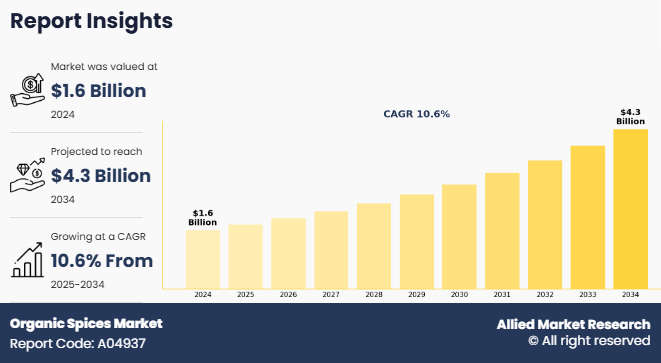
WILMINGTON, DE, UNITED STATES, December 9, 2025 /EINPresswire.com/ -- According to a new report published by Allied Market Research, titled, “Organic Spices Market," The organic spice market size was valued at $1.6 billion in 2024, and is estimated to reach $4.3 billion by 2034, growing at a CAGR of 10.6% from 2025 to 2034.Organic spices are grown organically without the application of synthetic chemicals, such as pesticides, herbicides, fertilizers, or genetically modified organisms (GMOs). These spices are grown using certified organic agricultural techniques that prioritize ecological sustainability, soil wellness, and biodiversity. Composting, crop rotation, biological pest management, and green manuring are common natural methods used in organic agriculture. Organic spices are gathered, processed, and packed without the use of artificial additives, preservatives, or irradiation, preserving their original fragrance, flavor, and nutritional characteristics. These spices, certified by regulatory agencies such as the USDA Organic, EU Organic, and India Organic, appeal to health-conscious customers and industries looking for cleaner, more sustainable, and ethically sourced products.
Download Sample Pages of Research Overview: https://www.alliedmarketresearch.com/request-sample/5300
The growing demand for clean-label products is a major driver propelling the organic spice market, as consumers increasingly seek food products that are natural, minimally processed, and free from synthetic additives. Clean label trends emphasize transparency, with consumers paying close attention to ingredient lists, sourcing practices, and certification labels such as USDA Organic or EU Organic. Organic spices align perfectly with this demand, offering a natural alternative to conventional spices that may contain artificial preservatives, colors, or flavor enhancers. Health-conscious consumers, especially millennials and Gen Z, are driving this shift by prioritizing products that promote wellness, environmental sustainability, and ethical sourcing. Food manufacturers and retailers are responding by reformulating their offerings and expanding clean label product lines to include organic spices and blends, both for direct consumption and as ingredients in packaged foods. This trend is also influencing restaurant menus, foodservice providers, and nutraceutical companies to opt for organic, clean-label spice ingredients.
The lack of awareness in developing regions is a significant factor restraining the organic spice market growth. In many low and middle-income countries, consumers are either unfamiliar with the concept of organic products or do not fully understand the health, environmental, and safety benefits they offer compared to conventional alternatives. Limited exposure to organic certification standards, inadequate promotional efforts, and a lack of government-driven educational campaigns contribute to this knowledge gap. Additionally, organic spices are often priced higher due to costlier production and certification processes, which can deter price-sensitive consumers who do not perceive added value due to low awareness. Retail penetration of organic products in rural and semi-urban areas is also limited, further restricting access and visibility. This lack of demand discourages local producers and retailers from investing in organic spice offerings, thereby creating a cyclical effect that hampers market expansion. Consequently, without targeted awareness programs and infrastructural support, the organic spice industry in developing regions continues to face slow adoption and limiting the organic spice market opportunities for growth.
LIMITED-TIME OFFER - Buy Now & Get Exclusive Discount on this Report @ https://www.alliedmarketresearch.com/checkout-final/8554bcc2a6e6ec3d1e6192d8fee69589
Export opportunities for producing countries represent a substantial growth avenue for the organic spice market, especially for nations with favorable agro-climatic conditions such as India, Sri Lanka, Vietnam, and Indonesia. These countries have traditionally been major spice producers and are now increasingly focusing on organic cultivation to capitalize on the rising global demand. With consumers in developed markets like North America, Europe, and parts of Asia-Pacific showing a strong preference for organic, sustainably sourced products, exporting certified organic spices offers a lucrative revenue stream. Government initiatives, trade agreements, and international certifications such as USDA Organic, EU Organic, and India Organic are further facilitating smoother market entry and compliance with global standards. Additionally, advancements in cold chain logistics, improved packaging solutions, and digital export platforms are enabling small and medium-sized producers to reach international buyers more efficiently. Exporting also helps stabilize domestic prices, promote rural employment, and encourage sustainable farming practices. Thus, the expansion of export opportunities for organic spice-producing countries is not only enhancing their economic prospects but also playing a pivotal role in scaling the global market.
The market is segmented into product type, form, distribution channel, and region. On the basis of product type, the market is categorized into organic ginger, organic turmeric, organic clove, organic pepper, organic cinnamon, organic nutmeg, organic mustard seeds, and others. On the basis of form, the market is divided into powder, granular, extract, and raw. On the basis of the distribution channel, the market is bifurcated into direct and indirect. Region-wise, the market is analyzed across North America (U.S., Canada and Mexico), Europe (France, Germany, Italy, Spain, UK, and Rest of Europe), Asia-Pacific (China, ASEAN, India, Australia, New Zealand, and Rest of Asia-Pacific) and LAMEA (Brazil, South Africa, Middle East, Argentina and Rest of LAMEA).
Enquiry Before Buying: https://www.alliedmarketresearch.com/purchase-enquiry/5300
Players operating in the market have adopted various developmental strategies to expand their organic spice market share, increase profitability, and remain competitive in the market. The key players profiled in the report include Ispice Foods, SunOpta Inc., AKO GmbH, Husarich GmbH, Organic Spices Inc., Pacific Spice Company Inc., Uk Blending Limited, Suminter India Organics, Ramon Sabater S.A.U, and Watkins Incorporated.
Key finding of the study
According to the organic spice industry analysis, on the basis of product type, the organic turmeric segment dominated the organic spice market in 2024 and is expected to retain its dominance throughout the forecast period.
According to the organic spice market trends, on the basis of form, the powder segment dominated the market in 2024 and is expected to retain its dominance throughout the forecast period.
On the basis of distribution channel, the indirect segment dominated the market in 2024 and is expected to retain its dominance throughout the forecast period.
By region, Asia-Pacific dominated the organic spices market in 2024 and is expected to retain its dominance throughout the organic spice market forecast period.
Trending Reports:
Organic Snacks Market: https://www.alliedmarketresearch.com/organic-snacks-market
Organic Beef Meat Market: https://www.alliedmarketresearch.com/organic-beef-meat-market
Organic Chicken Market: https://www.alliedmarketresearch.com/organic-chicken-market-A06859
David Correa
Allied Market Research
+ + + + + + + + + + + + +1 800-792-5285
email us here
Visit us on social media:
LinkedIn
Facebook
YouTube
X
What Sets Us Apart ? - Allied Market Research
Legal Disclaimer:
EIN Presswire provides this news content "as is" without warranty of any kind. We do not accept any responsibility or liability for the accuracy, content, images, videos, licenses, completeness, legality, or reliability of the information contained in this article. If you have any complaints or copyright issues related to this article, kindly contact the author above.
