

Global Penetration Testing Market Growth Driven by Cloud Security and PTaaS Adoption
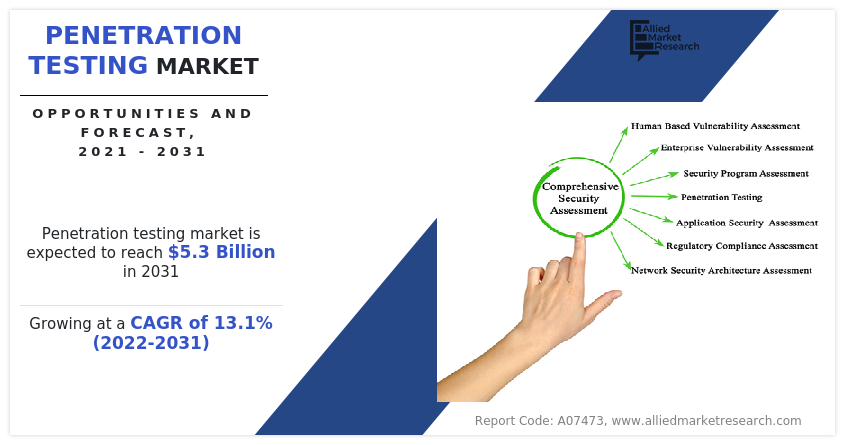
Penetration Testing Market is projected to reach $5.3 billion by 2031, driven by cloud adoption and rising cyber threats.
Growing cybersecurity concerns, PTaaS demand, and digital transformation fuel penetration testing market growth globally.”
WILMINGTON, DE, UNITED STATES, June 4, 2026 /EINPresswire.com/ -- — Allied Market Research
The global penetration testing market is experiencing substantial growth as organizations worldwide prioritize cybersecurity and proactive risk management. According to a recent report published by Allied Market Research, the market was valued at $1.6 billion in 2021 and is projected to reach $5.3 billion by 2031, registering a CAGR of 13.1% from 2022 to 2031.
The growing frequency of cyberattacks, increasing digital transformation initiatives, and widespread adoption of cloud-based technologies have elevated the importance of penetration testing across industries. Organizations are continuously seeking effective ways to identify vulnerabilities before cybercriminals can exploit them. As a result, penetration testing has become an essential component of modern cybersecurity strategies.
Download PDF Brochure: https://www.alliedmarketresearch.com/request-sample/A07473
The expansion of remote work environments, increasing regulatory compliance requirements, and rising investments in security infrastructure are further contributing to penetration testing market growth. As businesses become more dependent on digital systems and connected technologies, the need for comprehensive security assessments continues to increase.
Understanding Penetration Testing and Its Importance
Penetration testing is a specialized cyber security practice designed to identify vulnerabilities, weaknesses, and security gaps within software applications, networks, systems, and digital infrastructure. Often referred to as ethical hacking, penetration testing simulates real-world cyberattacks to evaluate how effectively an organization’s defenses can withstand malicious activities.
The primary purpose of penetration testing is to uncover potential security flaws before attackers can exploit them. Security professionals conduct controlled attacks on applications, databases, cloud environments, networks, and endpoints to assess the effectiveness of existing security measures.
Organizations use penetration testing to identify risks that could lead to unauthorized access, data breaches, financial losses, operational disruptions, and reputational damage. By proactively discovering vulnerabilities, businesses can strengthen their cybersecurity posture and reduce the likelihood of successful cyberattacks.
As digital ecosystems become increasingly complex, penetration testing has evolved from a periodic security exercise into a continuous cybersecurity requirement for organizations of all sizes.
Growing Cybersecurity Threat Landscape Fuels Market Expansion
One of the primary factors driving the penetration testing market is the rapid increase in cyber threats targeting organizations across industries. Cybercriminals are employing sophisticated attack techniques that exploit weaknesses in software applications, cloud infrastructure, networks, and connected devices.
Modern cyberattacks have become more advanced, involving ransomware, phishing campaigns, credential theft, insider threats, supply chain attacks, and advanced persistent threats. These attacks can cause severe financial losses, regulatory penalties, operational downtime, and long-term reputational damage.
As cyber risks continue to evolve, organizations are investing heavily in proactive security measures. Penetration testing enables businesses to identify vulnerabilities before attackers discover them, making it one of the most effective methods for improving cybersecurity readiness.
The increasing awareness of cybersecurity risks among business leaders and regulatory bodies is expected to remain a major growth driver for the penetration testing market throughout the forecast period.
Cloud Adoption Creating New Security Challenges
The rapid migration of business operations to cloud environments has significantly increased demand for penetration testing services. Organizations are embracing cloud computing to enhance scalability, flexibility, operational efficiency, and cost optimization.
However, cloud adoption introduces unique security challenges that require specialized testing methodologies. Misconfigured cloud environments, insecure APIs, weak access controls, and data exposure risks have become common concerns for enterprises operating in cloud ecosystems.
Penetration testing helps organizations evaluate cloud security controls, identify vulnerabilities, and ensure compliance with industry standards. Security teams conduct simulated attacks against cloud infrastructure to assess resilience against unauthorized access and data breaches.
As cloud-first strategies become standard across industries, the penetration testing market is expected to benefit from growing demand for cloud security assessments and vulnerability testing services.
Rising Number of Data Centers Supporting Market Growth
The increasing deployment of data centers worldwide is another key factor driving market expansion. Organizations are generating and storing massive volumes of data, requiring robust infrastructure capable of supporting digital operations.
Data centers house critical business information, making them attractive targets for cybercriminals. Security breaches involving data centers can have severe consequences, including financial losses, regulatory violations, and business disruption.
Penetration testing services help organizations evaluate the security of data center environments by identifying weaknesses in network architecture, access management systems, and infrastructure components. Regular security assessments ensure that vulnerabilities are addressed before they can be exploited.
The growing importance of secure data storage and processing capabilities continues to create significant opportunities for penetration testing providers globally.
Government Regulations Accelerating Adoption
Regulatory compliance has become a major factor influencing the growth of the penetration testing market. Governments and regulatory agencies worldwide are implementing stringent cybersecurity requirements aimed at protecting sensitive information and critical infrastructure.
Industries such as banking, healthcare, telecommunications, government, and energy are increasingly required to perform regular security assessments and vulnerability testing. Compliance frameworks often mandate penetration testing as part of broader cybersecurity risk management programs.
Organizations use penetration testing to demonstrate compliance with regulatory standards while improving overall security resilience. Failure to comply with cybersecurity regulations can result in substantial financial penalties and reputational consequences.
The continued introduction of data protection and cybersecurity regulations is expected to accelerate the adoption of penetration testing services during the forecast period.
Emergence of Penetration Testing as a Service (PTaaS)
One of the most significant trends shaping the penetration testing market is the growing popularity of Penetration Testing as a Service (PTaaS). This model combines traditional penetration testing methodologies with cloud-based platforms and continuous security monitoring capabilities.
PTaaS provides organizations with on-demand access to security testing services, enabling faster identification and remediation of vulnerabilities. Unlike conventional testing approaches that are performed periodically, PTaaS allows businesses to maintain ongoing visibility into their security posture.
The flexibility, scalability, and cost-effectiveness of PTaaS make it particularly attractive to organizations seeking continuous security validation. Businesses can access expert security resources without maintaining large internal cybersecurity teams.
As organizations increasingly prioritize agile security practices, PTaaS is expected to play a crucial role in driving future penetration testing market growth.
Network Penetration Testing Leads the Market
Among testing types, network penetration testing currently accounts for the largest share of the penetration testing market. Organizations depend heavily on interconnected networks to support business operations, communication, and data exchange.
Network penetration testing evaluates the security of internal and external network infrastructure, identifying vulnerabilities that could allow unauthorized access or malicious activities. Security professionals assess firewalls, routers, switches, wireless networks, and other critical components to identify potential attack vectors.
The increasing adoption of cloud technologies, remote work environments, and connected devices has expanded network attack surfaces, making network penetration testing more important than ever.
As organizations continue to modernize digital infrastructure, demand for comprehensive network security assessments is expected to remain strong.
Procure This Report (345 Pages PDF with Insights, Charts, Tables, and Figures): https://www.alliedmarketresearch.com/penetration-testing-market/purchase-options
Social Engineering Testing Expected to Grow Rapidly
While network penetration testing dominates the market, social engineering testing is projected to experience the fastest growth during the forecast period. Human error remains one of the most significant cybersecurity vulnerabilities within organizations.
Social engineering assessments evaluate how employees respond to simulated phishing attacks, fraudulent communications, and manipulation attempts. These tests help organizations identify weaknesses in security awareness and employee behavior.
The increasing adoption of Bring Your Own Device (BYOD) policies and remote working arrangements has heightened the importance of human-focused security assessments. Cybercriminals frequently target employees through phishing emails and social engineering techniques to gain unauthorized access to systems.
As organizations recognize the importance of addressing human vulnerabilities, social engineering testing is expected to become an increasingly important component of cybersecurity programs.
Impact of Remote Work on Security Testing Demand
The shift toward remote and hybrid work models has transformed cybersecurity requirements across industries. Employees now access corporate systems from multiple locations using various devices and networks, creating additional security challenges.
Remote work environments often increase exposure to cyber threats due to unsecured home networks, personal devices, and distributed access points. Organizations must ensure that security controls remain effective regardless of employee location.
Penetration testing helps businesses evaluate the security of remote access infrastructure, virtual private networks (VPNs), cloud applications, and collaboration platforms. Security assessments enable organizations to identify vulnerabilities associated with distributed work environments.
The continued adoption of flexible work arrangements is expected to drive sustained demand for penetration testing services throughout the forecast period.
COVID-19 Impact on the Penetration Testing Market
The COVID-19 pandemic significantly accelerated digital transformation and increased reliance on online services, creating new opportunities for the penetration testing market. Organizations faced unprecedented challenges as they rapidly transitioned to remote work and digital operations.
The surge in online transactions, cloud adoption, and remote connectivity expanded the attack surface for cybercriminals. As cyber threats increased during the pandemic, businesses intensified investments in cybersecurity solutions and penetration testing services.
Organizations recognized the importance of continuously evaluating their security posture to protect sensitive information and maintain operational continuity. Penetration testing became an essential tool for identifying vulnerabilities in newly deployed digital infrastructure.
The pandemic also accelerated adoption of PTaaS platforms, enabling organizations to conduct security assessments efficiently despite operational restrictions. These developments continue to influence market growth in the post-pandemic environment.
Regional Insights: North America Leads, Asia-Pacific Accelerates
North America accounted for the largest penetration testing market share in 2021 and is expected to maintain its leadership position during the forecast period. The region benefits from advanced technology adoption, mature cybersecurity frameworks, and significant investments in digital security.
Organizations across the United States and Canada are increasingly implementing penetration testing solutions to protect critical infrastructure, cloud environments, and enterprise networks. The widespread adoption of IoT technologies further contributes to market demand.
Meanwhile, Asia-Pacific is anticipated to witness the fastest growth rate over the coming years. Rapid digitalization, expanding IT sectors, growing startup ecosystems, and increasing cybersecurity awareness are fueling demand for penetration testing services throughout the region.
Countries such as India, China, Japan, South Korea, and Singapore are investing heavily in cybersecurity initiatives, creating significant opportunities for market participants.
Competitive Landscape
The penetration testing market features a diverse group of cybersecurity vendors and service providers competing through innovation, partnerships, acquisitions, and product development initiatives.
Key companies operating in the market include BreachLock Inc., Bugcrowd, Cigniti Technologies Ltd., Cisco Systems Inc., CovertSwarm, iSecuriON, Netragard, NetSPI LLC, NowSecure, PortSwigger Ltd., Rapid7, Reboot Security, SecurityMetrics, Trustwave Holdings Inc., Vumetric Cybersecurity, Astra Security, and Vairav Technology.
These organizations continue to expand their service portfolios by offering advanced penetration testing solutions, cloud security assessments, vulnerability management services, and PTaaS platforms. Strategic collaborations and technological advancements remain central to maintaining competitive advantages in the market.
Future Outlook
The future of the penetration testing market appears highly promising as cybersecurity continues to be a top priority for organizations worldwide. Increasing cyber threats, growing cloud adoption, expanding remote work environments, and stricter regulatory requirements will continue to drive demand for advanced security testing solutions.
Emerging technologies such as artificial intelligence, machine learning, automation, and cloud-native security platforms are expected to reshape penetration testing methodologies in the coming years. These innovations will enable faster vulnerability identification, improved threat simulation, and more efficient remediation processes.
As organizations seek proactive approaches to cybersecurity risk management, penetration testing will remain a critical component of enterprise security strategies.
Get a Customized Research Report: https://www.alliedmarketresearch.com/request-for-customization/A07473
Conclusion
The global penetration testing market is positioned for robust growth, rising from $1.6 billion in 2021 to an estimated $5.3 billion by 2031. Driven by escalating cyber threats, increasing cloud adoption, expanding regulatory requirements, and the emergence of PTaaS solutions, the market is becoming an essential pillar of modern cybersecurity programs.
Organizations across industries are recognizing the value of proactive vulnerability assessments and continuous security validation. As digital transformation accelerates and attack surfaces continue to expand, penetration testing will play an increasingly vital role in protecting business operations, safeguarding sensitive information, and ensuring long-term cyber resilience.
Trending Reports in Energy and Power Industry:
Penetration Testing Market
https://www.alliedmarketresearch.com/penetration-testing-market-A07473
smart cities market
https://www.alliedmarketresearch.com/smart-cities-market
DevOps Market
https://www.alliedmarketresearch.com/DevOps-market
cloud storage market
https://www.alliedmarketresearch.com/cloud-storage-market
cloud services market
https://www.alliedmarketresearch.com/cloud-services-market
Smart Locks Market
https://www.alliedmarketresearch.com/smart-locks-market
Enterprise Agile Transformation Services Market
https://www.alliedmarketresearch.com/enterprise-agile-transformation-services-market
Fitness App Market
https://www.alliedmarketresearch.com/fitness-app-market-A07465
Small Cell 5G Network Market
https://www.alliedmarketresearch.com/small-cell-5g-network-market
Online/Virtual Fitness Market
https://www.alliedmarketresearch.com/virtual-online-fitness-market
Online Trading Platform Market
https://www.alliedmarketresearch.com/online-trading-platform-market
IoT Market
https://www.alliedmarketresearch.com/internet-of-things-iot-market
Deep Learning Market
https://www.alliedmarketresearch.com/deep-learning-market
E-Learning Market
https://www.alliedmarketresearch.com/e-learning-market-A06253
Brain Computer Interface Market
https://www.alliedmarketresearch.com/brain-computer-interfaces-market
Algorithmic Trading Market
https://www.alliedmarketresearch.com/algorithmic-trading-market-A08567
Customer Relationship Management Market
https://www.alliedmarketresearch.com/crm-software-market
video analytics market
https://www.alliedmarketresearch.com/video-analytics-market
fraud detection & prevention market
https://www.alliedmarketresearch.com/fraud-detection-and-prevention-market
About Us
Allied Market Research (AMR) is a full-service market research and business-consulting wing of Allied Analytics LLP based in Portland, Oregon. Allied Market Research provides global enterprises as well as medium and small businesses with unmatched quality of "Market Research Reports" and "Business Intelligence Solutions." AMR has a targeted view to provide business insights and consulting to assist its clients to make strategic business decisions and achieve sustainable growth in their respective market domain.
Pawan Kumar, the CEO of Allied Market Research, is leading the organization toward providing high-quality data and insights. We are in professional corporate relations with various companies and this helps us in digging out market data that helps us generate accurate research data tables and confirms utmost accuracy in our market forecasting. Each and every data presented in the reports published by us is extracted through primary interviews with top officials from leading companies of domain concerned. Our secondary data procurement methodology includes deep online and offline research and discussion with knowledgeable professionals and analysts in the industry.
David Correa
Allied Market Research
+ + + + + + + + + + + + +1 800-792-5285
email us here
Visit us on social media:
LinkedIn
Facebook
YouTube
X
Legal Disclaimer:
EIN Presswire provides this news content "as is" without warranty of any kind. We do not accept any responsibility or liability for the accuracy, content, images, videos, licenses, completeness, legality, or reliability of the information contained in this article. If you have any complaints or copyright issues related to this article, kindly contact the author above.
