

Ambient Lighting Market to Witness Steady Growth, Reaching USD 173.6 Billion by the End of 2035
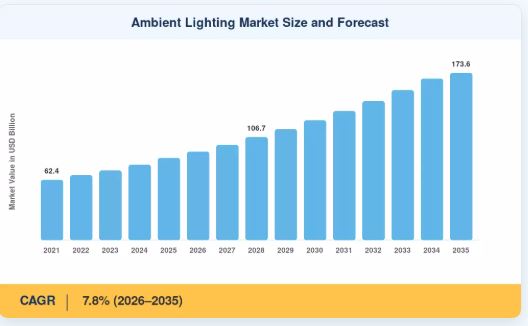
ambient lighting market
Ambient Lighting Market Size, Share and Research Report By Application (Residential, Commercial, Industrial, Architectural, Automotive), By Technology (LED)
Ambient Lighting Market: Driven by smart home adoption and automotive design trends, the ambient lighting market expands as demand grows for energy-efficient, customizable aesthetic experiences.”
TOKYO, TOKYO, JAPAN, July 23, 2026 /EINPresswire.com/ -- The Global ambient lighting market reached an estimated USD 85.2 billion in 2025 and is projected to grow from USD 91.8 billion in 2026 to USD 173.6 billion by 2035, registering a CAGR of 7.8% during the forecast period. Two major catalysts are accelerating this trajectory: the global smart home boom, which saw connected lighting installations surpass 1.2 billion units in 2024, and stringent energy efficiency mandates including the EU’s revised Ecodesign Regulation and the U.S. Department of Energy’s updated lamp standards that are compelling commercial and residential end-users alike to migrate from legacy incandescent and fluorescent fixtures to intelligent, tunable LED ambient systems. With smart building automation spending projected to exceed USD 150 billion globally by 2030, architects, interior designers, and facility managers face mounting pressure to integrate adaptive ambient lighting or risk delivering suboptimal occupant experiences.— Market Research Future (MRFR)
Legacy fixed-output luminaires many relying on manual dimmer switches and single-color temperature lamps are rapidly giving way to tunable white and RGBW LED ambient platforms that integrate circadian rhythm scheduling, occupancy-based daylight harvesting, and voice or app-driven scene control. A recent McKinsey Global Institute report estimated that top-quartile commercial real estate operators deploying human-centric lighting alongside building management systems achieved 19–24% improvements in measured occupant productivity and well-being scores versus peers relying on conventional static lighting. This technology shift is not incremental it represents a structural re-platforming of how the entire built environment manages light as a dynamic, data-driven resource.
Get Full PDF Sample Copy of Report: (Including Full TOC, List of Tables & Figures, Chart) @
https://www.marketresearchfuture.com/sample_request/4196
➤ How Significant Is the Ambient Lighting Market’s Growth?
The ambient lighting market has demonstrated consistent and robust expansion, rising from approximately USD 8.61 billion in 2021 to an estimated USD 85.2 billion in 2025, representing a healthy historical growth trajectory. The market is expected to more than double over the next decade, driven by the convergence of smart building automation, the proliferation of IoT-enabled LED luminaires, and growing consumer and enterprise demand for personalized, health-supportive lighting environments.
Rising awareness of light’s impact on human circadian rhythms, sleep quality, and cognitive performance has created acute demand for tunable, biologically-optimized ambient lighting solutions across healthcare, hospitality, education, and office sectors. Property developers, hotel chains, hospital administrators, and corporate real estate teams are all investing heavily in dedicated ambient lighting platforms to differentiate their environments, reduce energy operating costs, and meet evolving green building certification requirements.
➤ What Does the Future Hold for the Ambient Lighting Market?
Human-centric lighting (HCL) and IoT integration stand at the forefront of the market’s next growth phase. AI-driven ambient lighting platforms are transforming illumination from a passive background utility into a dynamic wellness and productivity tool. Intelligent lighting control systems now adjust color temperature and intensity in real time based on occupancy sensor data, time of day, outdoor luminance levels, and individual user preferences delivering personalized ambient environments that adapt continuously throughout the day.
The growing emphasis on sustainable building design is another defining force shaping the market’s future. Net-zero carbon commitments across commercial real estate, healthcare, and education sectors are accelerating the retirement of energy-intensive conventional lighting in favor of LED ambient systems with daylight harvesting, occupancy-responsive controls, and detailed energy consumption reporting. Buildings certified under LEED v4.1, WELL Building Standard, and BREEAM frameworks increasingly mandate advanced ambient lighting performance as a prerequisite for certification.
Wireless lighting control protocols are also redefining installation economics. The maturation of Zigbee, Z-Wave, Bluetooth Mesh, and the emerging Matter standard is enabling large-scale ambient lighting deployments without costly hardwired control infrastructure dramatically reducing retrofit costs in existing commercial and residential buildings and opening vast new addressable markets.
Direct Purchase this Research Report:
https://www.marketresearchfuture.com/checkout?currency=one_user-USD&report_id=4196
➤ Who Are the Key Players in the Ambient Lighting Market?
The ambient lighting landscape is characterized by a mix of global lighting conglomerates, specialized smart lighting technology providers, and rapidly scaling IoT-native startups. Key participants shaping the competitive dynamics include:
★ Signify (Philips Hue) — the world’s largest lighting company, offering the broadest consumer and professional smart ambient lighting ecosystem globally
★ OSRAM Licht AG — delivering professional LED and intelligent lighting solutions across automotive, horticulture, and architectural ambient segments
★ Acuity Brands — providing advanced LED luminaires and networked lighting control systems for commercial and industrial ambient applications
★ Lutron Electronics — specializing in precision dimming, shading, and whole-home/whole-building ambient lighting control platforms
★ Cree Lighting — offering high-performance commercial LED ambient solutions with emphasis on energy efficiency and longevity
★ General Electric Current — delivering intelligent commercial ambient lighting systems integrated with building energy management platforms
★ Zumtobel Group — providing human-centric lighting solutions and connected ambient systems for healthcare, office, and education environments
★ Legrand — offering integrated electrical infrastructure and smart ambient lighting control solutions for residential and commercial applications
★ Hubbell Lighting — delivering a broad portfolio of commercial and industrial ambient luminaires with advanced IoT connectivity
★ Eaton Corporation (Ephesus Lighting) — providing sports, industrial, and commercial ambient LED systems with networked control capabilities
Competition in the market is intensifying as vendors race to embed generative AI scene-creation capabilities, expand Matter-compatible product ecosystems, and deepen integrations with smart home platforms (Amazon Alexa, Google Home, Apple HomeKit) and enterprise building management systems. Strategic partnerships with real estate developers, interior design firms, and smart building platform providers are reshaping the competitive landscape.
➤ What Are the Emerging Trends in the Ambient Lighting Market?
Several transformational trends are redefining how the ambient lighting market evolves through 2035:
Human-Centric Lighting (HCL) Adoption: Circadian-rhythm-aligned tunable white lighting systems that dynamically shift color temperature and intensity across the day are transitioning from premium niche to mainstream specification across healthcare, education, and corporate office environments.
Matter Protocol Unification: The emergence of the Matter smart home interoperability standard is consolidating fragmented smart lighting ecosystems, enabling seamless cross-brand ambient control and dramatically lowering the integration friction for end-users and installers alike.
Li-Fi and Visible Light Communication (VLC): Ambient LED luminaires doubling as high-speed wireless data transmission nodes are moving from laboratory proof-of-concept to initial commercial deployments in secure enterprise, healthcare, and aviation environments.
Generative AI Scene Design: AI tools enabling automatic generation of personalized ambient lighting scenes based on room occupancy patterns, calendar data, biometric inputs, and aesthetic preferences are emerging as differentiating platform features for premium smart lighting vendors.
Architectural Integration & Invisible Lighting: Growing demand for lighting solutions fully integrated into architectural elements recessed ceilings, luminous walls, embedded furniture lighting is driving innovation in ultra-thin LED panels, flexible OLED luminaires, and light-diffusing building materials.
Horticulture & Wellness Lighting Convergence: The intersection of plant-growth spectrum research and human wellness lighting science is creating new ambient product categories that simultaneously optimize environments for both occupant well-being and integrated indoor horticulture applications.
Get access to the full description of the report @
https://www.marketresearchfuture.com/reports/ambient-lighting-market-4196
➤ How Is the Ambient Lighting Market Segmented?
The ambient lighting market report provides a comprehensive segmentation framework:
1 By Light Source: LED, Fluorescent, Halogen, Incandescent, OLED
2 By Installation Type: New Installation, Retrofit & Replacement
3 By Control System: Wired (DALI, KNX), Wireless (Zigbee, Z-Wave, Bluetooth Mesh, Matter), Standalone Dimmer
4 By End-Use Vertical: Residential, Commercial Office, Hospitality, Healthcare, Retail, Education, Industrial
5 By Distribution Channel: Direct Sales & Specification, Electrical Distributors, Online Retail, Interior Design & AV Integrators
➤ What Are the Regional Insights from the Ambient Lighting Market?
North America commands approximately 35% of global ambient lighting market share, underpinned by the region’s advanced smart home adoption, mature commercial real estate sector, and stringent Department of Energy efficiency standards that incentivize rapid LED ambient adoption. The U.S. remains the single largest national market, driven by substantial commercial office, healthcare, and hospitality renovation spending.
Europe holds the second-largest share at approximately 28%, with Germany, the United Kingdom, the Netherlands, and the Nordic countries representing the primary markets. The EU’s aggressive energy efficiency directives including the revised Energy Performance of Buildings Directive (EPBD) mandating near-zero energy standards for all new buildings are compelling architects and facility managers to specify advanced ambient lighting control systems as standard practice rather than premium optional upgrades.
Asia-Pacific represents the fastest-growing major region, driven by rapid urbanization, massive hospitality and commercial real estate construction pipelines across China, India, and Southeast Asia, and a thriving consumer smart home market in Japan, South Korea, and Australia. Government smart city initiatives across the APAC region are expected to generate particularly strong demand for networked ambient lighting infrastructure through 2035.
Middle East & Africa is projected to register the highest CAGR at approximately 10.1% through 2035. Landmark giga-projects across Saudi Arabia, the UAE, and Qatar including NEOM, Qiddiya, and Lusail City are specifying state-of-the-art ambient and architectural lighting at unprecedented scale, while rapid urbanization across Sub-Saharan Africa is driving strong baseline demand for energy-efficient LED ambient solutions.
South America rounds out the global picture, with Brazil, Mexico, Colombia, and Chile representing the most active markets. Growing hospitality sector investment, expanding commercial real estate construction, and government-backed energy efficiency programs are the primary drivers of ambient lighting market growth across the region.
➤➤➤ Industry Analysis Reports by Market Research Future:
Industry 5 0 Market-
https://www.marketresearchfuture.com/reports/industry-5-0-market-29201
Digital Braille Display Market-
https://www.marketresearchfuture.com/reports/digital-braille-display-market-32356
Automotive Manufacturing Equipment Market-
https://www.marketresearchfuture.com/reports/automotive-manufacturing-equipment-market-32767
Free Space Optic Communication Market-
https://www.marketresearchfuture.com/reports/free-space-optic-communication-market-32969
Event Insurance Market-
https://www.marketresearchfuture.com/reports/event-insurance-market-33031
Industrial Cable Market-
https://www.marketresearchfuture.com/reports/industrial-cable-market-33591
Lidar In Mapping Market-
https://www.marketresearchfuture.com/reports/lidar-in-mapping-market-33766
Video Switcher Market-
https://www.marketresearchfuture.com/reports/video-switcher-market-34255
Quantum High Performance Computing Market-
https://www.marketresearchfuture.com/reports/quantum-high-performance-computing-market-34665
Retail Display Market-
https://www.marketresearchfuture.com/reports/retail-display-market-34742
Sagar Kadam
Market Research Future
+ + +1 628-258-0071
email us here
Legal Disclaimer:
EIN Presswire provides this news content "as is" without warranty of any kind. We do not accept any responsibility or liability for the accuracy, content, images, videos, licenses, completeness, legality, or reliability of the information contained in this article. If you have any complaints or copyright issues related to this article, kindly contact the author above.
