

Data Center Server Market to Reach USD 471.90 Billion at 14.9% CAGR by 2035
Data Center Server Market
Data Center Server Market grows with cloud adoption, AI workloads, virtualization, and rising demand for high-performance computing.
Data Center Server Market growth is driven by AI workloads, cloud computing, virtualization, and rising demand for scalable, high-performance infrastructure.”
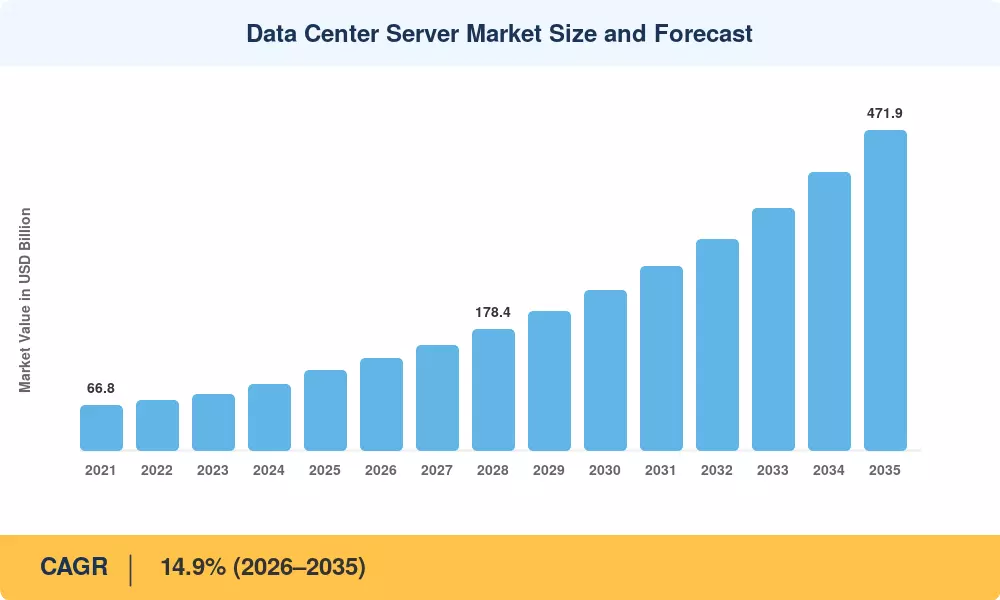
NEW YORK(NY), NY, UNITED STATES, September 2, 2026 /EINPresswire.com/ -- The Data Center Server Market reached an estimated USD 117.70 Billion in 2025 and is projected to grow from USD 135.10 Billion in 2026 to USD 471.90 Billion by 2035, registering a 14.9% CAGR throughout the forecast period. Rising cloud adoption, AI workloads, digital services, and enterprise data generation are increasing demand for high-performance server infrastructure.— Market Research Future
North America led global demand with a 42.6% revenue share in 2025, supported by major hyperscale campus investments exceeding USD 50 billion annually. The region benefits from mature cloud infrastructure, advanced enterprise computing ecosystems, and significant investments in artificial intelligence and data-intensive applications.
Asia-Pacific is forecast to post the highest regional growth at a 16.8% CAGR through 2035. Rapid digital transformation, expanding cloud services, e-commerce growth, data localization requirements, and increasing investments in hyperscale and colocation facilities are strengthening demand for advanced data center server infrastructure across the region.
Download Sample Pages of Research Overview -
https://www.marketresearchfuture.com/sample_request/29431
Data Center Server Industry Overview
Data center servers provide the computational foundation required to run applications, databases, cloud platforms, artificial intelligence systems, enterprise software, and digital services. As organizations generate and process increasingly large volumes of information, demand is shifting toward servers capable of delivering higher performance, scalability, energy efficiency, and reliability.
The industry is also being reshaped by the expansion of hyperscale facilities and hybrid IT environments. Market Research Future identifies cloud adoption, hybrid solutions, AI integration, automation, and growing demand for data processing as important factors influencing the broader data center server landscape.
Topical Authority: Adaptive Learning Market
A relevant topical authority keyword for the Data Center Server Market is the Adaptive Learning Market, because both areas increasingly depend on cloud computing, artificial intelligence, analytics, scalable infrastructure, and real-time data processing. Market Research Future highlights AI and analytics and cloud computing as important technologies within adaptive learning ecosystems.
The connection is particularly important because adaptive digital platforms continuously process user information, generate insights, and personalize experiences. Such workloads require dependable computing resources and scalable server infrastructure. As AI-powered applications become more sophisticated, the underlying demand for data center servers can expand across education technology, enterprise software, analytics, and other digital industries.
Key Market Growth Drivers
The increasing adoption of cloud computing is a major growth driver for the Data Center Server Market. Public cloud, private cloud, and hybrid environments require substantial computing capacity to support applications, databases, storage, analytics, and digital workloads. Cloud service providers are therefore expanding server deployments to accommodate growing customer demand and increasingly complex workloads.
Artificial intelligence and machine learning are creating another powerful source of demand. AI workloads often require high-performance processors, accelerators, large memory capacities, and fast networking technologies. As enterprises deploy generative AI, predictive analytics, computer vision, and automation applications, data centers are increasingly upgrading server architectures to handle computationally intensive workloads.
Artificial Intelligence and High-Performance Computing
AI is transforming server design by increasing requirements for accelerated computing and high-speed data movement. Conventional enterprise workloads can often operate on general-purpose processors, while AI training and inference may require specialized accelerators, advanced memory architectures, and high-bandwidth networking. This transition is encouraging data center operators to modernize infrastructure.
The growing adoption of AI also increases the importance of server efficiency. Operators must balance computational performance with power consumption, cooling requirements, and physical space. Consequently, manufacturers are focusing on higher compute density, improved thermal management, energy-efficient processors, and architectures capable of supporting demanding AI and analytics workloads.
Server Form Factor Segmentation
By form factor, the Data Center Server Market includes rack-mounted servers, blade servers, tower servers, modular servers, and microservers. Rack-mounted servers remain highly relevant because they provide efficient use of data center space and can be deployed in scalable configurations. Their flexibility makes them suitable for enterprise, cloud, colocation, and hyperscale environments.
Blade and modular servers are also gaining attention where organizations prioritize density and efficient infrastructure management. Microservers can serve specialized workloads requiring lower computational capacity, while tower servers remain useful in smaller deployments and organizations with limited infrastructure requirements. Market Research Future identifies form factor as a major segmentation category for the industry.
Processor Technology Trends
Processor architecture is becoming increasingly diverse as workloads evolve. X86 processors continue to support a broad range of enterprise and cloud applications, while ARM-based architectures are gaining attention for workloads where performance per watt, scalability, and energy efficiency are important considerations.
Power and SPARC processors also occupy specialized segments, particularly where organizations maintain specific legacy or high-reliability workloads. Meanwhile, accelerator technologies are becoming increasingly significant for AI and high-performance computing. The evolution toward heterogeneous computing is expected to influence future server procurement decisions as data center operators match processor architectures with individual workload requirements.
Buy Now Get Comprehensive Market Insights -
https://www.marketresearchfuture.com/checkout?currency=one_user-USD&report_id=29431
Memory and Storage Evolution
Modern applications require fast access to increasingly large datasets, making memory technology a critical component of server performance. DRAM remains fundamental, while newer technologies and architectures are being evaluated for workloads that require high capacity, low latency, or persistent data access. Memory optimization is particularly important for AI, analytics, databases, and virtualization.
Storage technologies are also evolving as organizations prioritize faster data access and improved application responsiveness. SSD, NVMe, and all-flash storage solutions can deliver higher performance than conventional hard disk-based configurations for many workloads. The increasing use of data-intensive applications is therefore encouraging data center operators to modernize both server and storage architectures.
Networking Infrastructure and Server Performance
Server performance increasingly depends on high-speed networking because modern applications frequently distribute workloads across multiple systems. Ethernet remains widely deployed, while InfiniBand, Fibre Channel, and RoCE support specialized high-performance and storage-intensive environments. Fast interconnects are especially important for AI clusters and distributed computing architectures.
As data center workloads become more distributed, networking and server technologies are becoming increasingly interconnected. Operators need infrastructure that can minimize bottlenecks between compute, storage, and networking layers. This trend is supporting investment in high-bandwidth connectivity, advanced switching, and architectures designed for accelerated computing environments.
Cloud and Hyperscale Data Center Expansion
Hyperscale cloud providers represent a major source of server demand because they operate extensive computing infrastructures supporting millions of users and applications. Continued migration toward cloud platforms requires additional server capacity, particularly as businesses move enterprise applications, analytics, databases, and AI workloads to cloud environments.
Hyperscale expansion is also encouraging manufacturers to develop standardized, scalable, and energy-efficient server platforms. Large operators can deploy thousands of systems at a time, creating demand for solutions optimized for procurement efficiency, remote management, automation, maintenance, and total cost of ownership. This trend is expected to remain central to industry growth through 2035.
Energy Efficiency and Sustainability
Energy consumption is becoming a critical consideration for data center operators as server deployments increase. Higher compute density can improve space utilization but may also raise power and cooling requirements. Consequently, operators are increasingly evaluating processor efficiency, server utilization, workload optimization, and cooling technologies when planning infrastructure investments.
Sustainability initiatives are also influencing server design and operational practices. Market Research Future notes that energy efficiency is becoming an important factor in data center server innovation, while AI and automation are increasingly being incorporated to improve operational efficiency.
Regional Market Insights
North America remains the leading regional contributor, accounting for 42.6% of global revenue in 2025 according to the supplied market outlook. Strong hyperscale investment, cloud adoption, enterprise technology spending, and AI infrastructure development are supporting regional demand. The presence of major technology companies and established data center ecosystems further reinforces the region's position.
Asia-Pacific is expected to record the fastest growth at a 16.8% CAGR through 2035. Expanding internet usage, digital commerce, cloud migration, AI adoption, and data center construction are contributing to server demand. Emerging economies are also increasing investments in digital infrastructure, creating new opportunities for server manufacturers, cloud providers, and data center operators.
Competitive Landscape
The competitive environment includes major technology companies such as Hewlett Packard Enterprise, Dell Technologies, IBM, Cisco Systems, Lenovo, Fujitsu, Supermicro, Oracle, and Huawei. These companies compete through server performance, processor compatibility, energy efficiency, scalability, networking capabilities, management software, and enterprise support.
Competition is increasingly centered on specialized infrastructure for AI and high-performance workloads. Manufacturers are investing in accelerated computing, optimized cooling, advanced memory, high-speed networking, and modular architectures. Strategic partnerships between server manufacturers, semiconductor companies, cloud providers, and software developers are also helping organizations deploy integrated computing environments.
Emerging Opportunities
The rapid adoption of generative AI presents a major opportunity for server manufacturers and data center operators. AI models require substantial compute, memory, and networking resources, encouraging investment in new server configurations. Demand is likely to remain strong as businesses integrate AI into customer service, software development, analytics, cybersecurity, healthcare, manufacturing, and financial applications.
Edge computing is another emerging opportunity. As organizations seek to process data closer to end users and connected devices, smaller distributed data centers require compact and efficient server infrastructure. Edge servers can support applications such as industrial automation, smart cities, connected vehicles, content delivery, and real-time analytics where low latency is essential.
Key Challenges
High infrastructure costs remain a significant challenge. Advanced servers designed for AI and high-performance computing can require substantial capital investment, while power and cooling requirements increase operational expenses. Data center operators must therefore evaluate performance against total cost of ownership and long-term energy consumption.
Supply chain constraints and semiconductor availability can also affect server deployment schedules. In addition, rapidly changing processor architectures and accelerated computing technologies can shorten equipment refresh cycles. Organizations need flexible procurement and infrastructure strategies to avoid technology obsolescence while maintaining reliable performance.
Future Outlook
The Data Center Server Market is positioned for strong long-term expansion as cloud computing, AI, digital transformation, edge computing, and data-intensive applications continue to develop. Based on the supplied forecast, revenue is expected to rise from USD 117.70 Billion in 2025 to USD 471.90 Billion by 2035 at a 14.9% CAGR.
Future server infrastructure is likely to become more intelligent, energy efficient, modular, and optimized for specialized workloads. AI accelerators, advanced processors, high-speed networking, liquid cooling, and intelligent infrastructure management are expected to influence investment decisions. The growing integration of AI and cloud computing across industries will further strengthen demand for scalable data center computing resources.
Browse Full Report Details -
https://www.marketresearchfuture.com/reports/data-center-server-market-29431
Key Takeaways
The Data Center Server Market is expanding rapidly as enterprises and cloud providers require greater computing capacity, improved performance, and scalable infrastructure. AI, cloud migration, hyperscale expansion, edge computing, and digital transformation are among the strongest factors supporting demand.
North America currently leads the industry, while Asia-Pacific is expected to deliver the fastest growth through 2035. As server technologies evolve, manufacturers that combine high performance, energy efficiency, advanced networking, flexible architectures, and AI readiness are likely to capture significant opportunities in the expanding data center ecosystem.
Frequently Asked Questions
What is the Data Center Server Market size in 2025?
The market reached an estimated USD 117.70 Billion in 2025.
What will the market reach by 2035?
It is projected to reach USD 471.90 Billion by 2035.
What is the expected CAGR?
The supplied forecast indicates a 14.9% CAGR from 2026 to 2035.
Which region leads the market?
North America led with a 42.6% revenue share in 2025.
Which region is growing fastest?
Asia-Pacific is forecast to grow at a 16.8% CAGR through 2035.
What is driving server demand?
Cloud adoption, AI workloads, hyperscale expansion, and digital transformation are major drivers.
What technologies are important for modern servers?
Advanced processors, AI accelerators, high-speed networking, NVMe storage, and energy-efficient architectures are important.
How is AI affecting data center servers?
AI is increasing demand for high-performance computing, accelerators, large memory capacities, and high-bandwidth networking.
➤➤ Expert Market Forecasts from Market Research Future:
Cloud Content Delivery Network Market-
https://www.marketresearchfuture.com/reports/cloud-content-delivery-network-market-4869
Mobile Gambling Market-
https://www.marketresearchfuture.com/reports/mobile-gambling-market-5142
Cloud Managed Services Market-
https://www.marketresearchfuture.com/reports/cloud-managed-services-market-5515
Enterprise Portal Market-
https://www.marketresearchfuture.com/reports/enterprise-portal-market-5725
Cloud Database Market-
https://www.marketresearchfuture.com/reports/cloud-database-market-6847
Ai As A Service Market-
https://www.marketresearchfuture.com/reports/ai-as-a-service-market-7059
Identity As A Service Market-
https://www.marketresearchfuture.com/reports/identity-service-market-7928
Intranet As A Service Market-
https://www.marketresearchfuture.com/reports/intranet-service-market-8084
Key Management As A Service Market-
https://www.marketresearchfuture.com/reports/key-management-service-market-8188
Unified Communication As A Service Market-
https://www.marketresearchfuture.com/reports/unified-communication-service-market-8721
Structural Health Monitoring Market-
https://www.marketresearchfuture.com/reports/structural-health-monitoring-market-10855
Machine Vision Market-
https://www.marketresearchfuture.com/reports/machine-vision-market-1510
Workforce Management Market-
https://www.marketresearchfuture.com/reports/workforce-management-market-2388
Market Research Future
Market Research Future
+1 855-661-4441
email us here
Legal Disclaimer:
EIN Presswire provides this news content "as is" without warranty of any kind. We do not accept any responsibility or liability for the accuracy, content, images, videos, licenses, completeness, legality, or reliability of the information contained in this article. If you have any complaints or copyright issues related to this article, kindly contact the author above.
